 how-to
Long Term Loc Maintenance Services: A Complete Guide
Last Updated: October 24, 2026
Quick Summary
Long term loc maintenance services are recurring professional appointments that keep established locs clean, retwisted, repaired, and styled over months and years. At Precious B Artistry, we structure loc maintenance around four pillars: root retwisting, washing and scalp care, repair and reconstruction, and styling.
- Book maintenance as a package, not a single service, so inspection and separation work is never skipped.
- Most people with mature locs should book a retwist every four to six weeks.
- Mature locs should be washed every two to four weeks, and always before a retwist.
- Choose a loctician by portfolio, consultation quality, and consistency, not by price alone.
- A full maintenance session typically costs $100-$180 every 4-6 weeks.
Table of Contents
- Long Term Loc Maintenance Services: What They Include
- How to Maintain Locs Between Professional Visits
- Loc Retwist Timing: How Often Should You Book?
- Loc Washing Frequency for Healthy Locs
- Loc Repair and Reconstruction Services
- Choosing a Loctician for Long Term Loc Maintenance Services
- What Long Term Loc Maintenance Services Cost
- Conclusion
- Frequently Asked Questions
Long Term Loc Maintenance Services: What They Include
Long term loc maintenance services are recurring professional appointments that keep established locs clean, retwisted, repaired, and styled over months and years. At Precious B Artistry, we structure loc maintenance around four pillars: root retwisting, washing and scalp care, repair and reconstruction, and styling.
Most people picture a retwist and stop there. That's the mistake.
A proper maintenance service covers the whole system. Your stylist checks each loc for thinning at the root, separates any locs that have started to marry, cleans the scalp, and only then retwists new growth.
Here's what a full session typically includes:
- Root retwisting to control new growth and keep parts clean
- Scalp cleansing with residue-free shampoo
- Loc separation to prevent joining at the base
The difference between a quick retwist and a full maintenance session shows up a year later. Locs maintained with regular inspection hold their shape. Locs maintained with retwists alone tend to thin unevenly.
How to Maintain Locs Between Professional Visits
Between appointments, your job is simple: keep the scalp clean, keep the roots separated, and keep your hands out of your hair. Most loc damage we see starts at home, not in the salon chair.
Daily Care and Scalp Health
Mist your locs lightly with water or a water-based spray when they feel dry. Massage your scalp with your fingertips, not your nails, to keep circulation going and loosen buildup.
If your scalp itches, resist scratching at the root. Use a soft bristle brush or a damp cloth instead.
Sleep with your locs covered. A satin or silk scarf or bonnet reduces friction and keeps lint out of the hair.
Products That Help and Products That Hurt
Less product is almost always better. Heavy waxes, gels, and butters sit at the base of the loc and trap lint, dust, and dead skin. Over time that buildup hardens and becomes very difficult to remove without cutting.
What helps:
- Water-based moisturizing sprays for daily hydration
- Residue-free shampoo designed for locs
- Light oils applied to the scalp, not the length of the loc
What hurts:
- Heavy waxes and petroleum-based pomades
- Silicone-heavy serums that coat the loc
- Conditioners that don't rinse clean
If you can see white residue at your roots after your hair dries, your product is building up. Tell your stylist at your next appointment so they can assess it.
Loc Retwist Timing: How Often Should You Book?
Most people with mature locs should book a retwist every four to six weeks. That range keeps new growth manageable without over-manipulating the roots. Tightening too often weakens the base; waiting too long lets locs merge and makes separation painful.
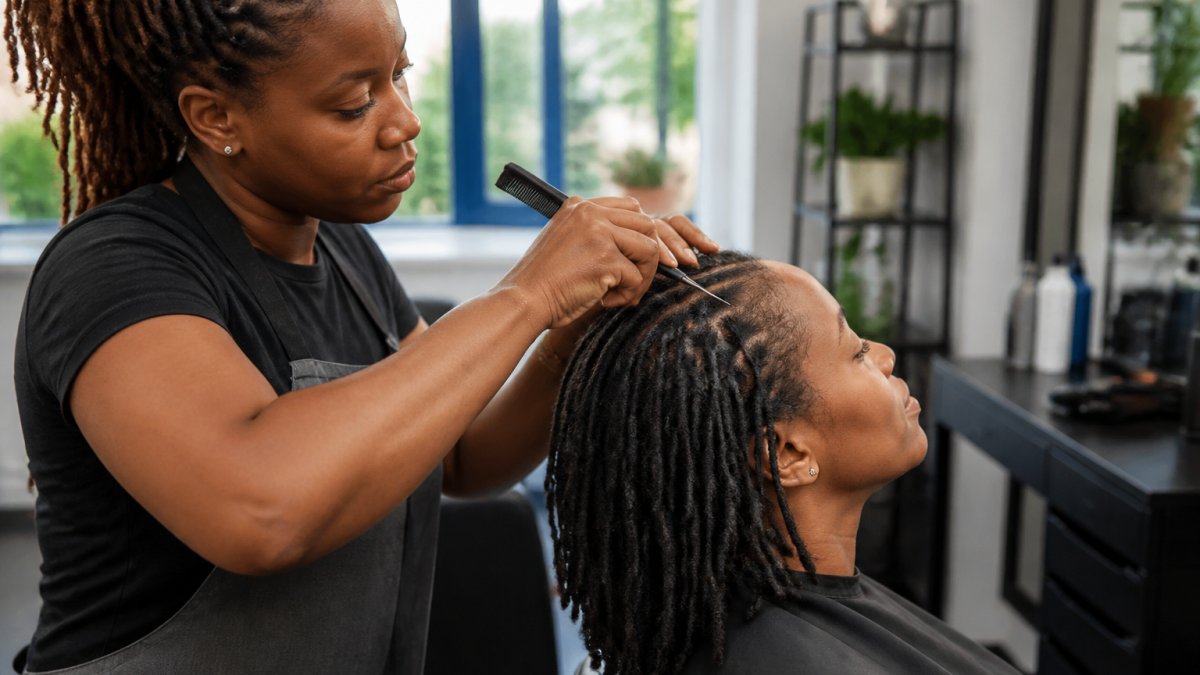
That range is a starting point, not a rule. The right interval depends on your loc maturity, hair texture, growth rate, lifestyle, and scalp condition. Use the framework below to build a schedule instead of booking by the calendar alone.
Match the Interval to Your Maintenance Method
Retwisting, interlocking, and crochet maintenance put different stress on the root, so they run on different clocks.
- Palm-roll or comb retwist: Every 4-6 weeks for mature locs. This method relies on product and tension at the base, so stretching past six weeks lets new growth puff out and locs marry. Tightening every two weeks is too aggressive and thins the root.
- Interlocking: Every 6-8 weeks. Interlocking creates a tighter, more durable root, so it holds longer and tolerates a wider gap. Because each rotation adds a small amount of tension, going shorter than six weeks repeatedly can stress the scalp.
- Crochet maintenance: Every 6-8 weeks, and sometimes up to 10 weeks for strong, mature locs. Crochet pulls loose hair back into the loc rather than wrapping the root, so it is gentler on the base and suits clients with sensitive scalps or fragile roots.
If you switch methods, reset the clock. A client moving from retwist to interlock should not expect the same four-week cadence.
Adjust for Maturity, Texture, and Lifestyle
Four factors should move your interval up or down:
- Loc maturity. Starter and teenage locs need closer attention. Fully mature locs (usually two years or older) can stretch intervals if the roots stay clean and separated.
- Hair texture and density. Fine or fragile hair benefits from gentler handling and a slightly longer gap between retwists. Thick, dense hair can produce visible new growth faster and may need a tighter schedule.
- Growth rate. If your parts look fuzzy within three weeks, your hair grows quickly and a four-week cadence fits. If new growth is barely visible at six weeks, you can safely wait.
- Lifestyle and scalp. Heavy sweating, frequent workouts, humid climates, and oily scalps push you toward the shorter end. Dry scalps and low-activity routines can stretch toward the longer end.
A Simple Self-Check Before Booking
Ask yourself three questions:
- Is new growth visible enough that parts look fuzzy?
- Are any locs starting to join at the base?
- Does your scalp feel like it needs a professional cleanse?
Two or more yes answers means it is time. A common mistake is booking retwists by the calendar alone and ignoring what the hair is actually doing.
Loc Washing Frequency for Healthy Locs
Mature locs should be washed every two to four weeks, and always before a retwist. Clean hair holds a retwist better, and a clean scalp is the foundation of healthy locs.
The old advice to avoid washing locs is outdated for established locs. Once your locs have matured, regular washing removes buildup that no amount of retwisting can fix.
Starter locs are the exception. In the first few months, wash less often and follow your stylist's guidance on protecting the newly formed locs.
If you work out regularly or live somewhere humid, you may need to wash closer to the two-week mark.
Loc Repair and Reconstruction Services
Loc repair fixes individual damaged locs, while reconstruction rebuilds locs that have thinned or broken beyond simple repair. Both are routine services for anyone committed to long term loc maintenance.
Thinning, Breakage, and Reattachment
Thinning usually starts at the root. You'll notice a loc that feels narrower near the scalp than at the tip, or one that wobbles when you touch it.
Reattachment is the service that reconnects a broken loc to the healthy root above it.
Signs you need repair work:
- A loc that feels loose or spongy at the base
- Visible narrowing near the root
- A loc that has broken off entirely
Reconstruction is the heavier option. It rebuilds a damaged section of the loc, sometimes using crochet maintenance to interlock the hair back into a solid structure.
Choosing a Loctician for Long Term Loc Maintenance Services
Choose a loctician by portfolio, consultation quality, and consistency, not by price alone.
Start with photos. Ask to see locs they have maintained over time, not just fresh retwists.
Then book a consultation.
Questions worth asking:
- How long have you been working with locs?
- Do you handle repair and reconstruction, or refer it out?
- What's your approach for sensitive scalps?
At Precious B Artistry, our consultation process exists for exactly this reason.
One more thing: ask about tension. If you've had headaches from tight styling, say so up front.
What Long Term Loc Maintenance Services Cost
Pricing for loc maintenance depends on loc length, density, the method used, and how much repair work is needed, so most salons quote after a consultation rather than from a flat menu. Expect the final price to reflect the time your specific locs require.
| Service | Typical Price Range | Typical Interval |
|---|---|---|
| Basic retwist (shoulder length) | $65-$120 | Every 4-6 weeks |
| Full maintenance session (retwist, wash, inspection, separation) | $100-$180 | Every 4-6 weeks |
| Interlocking | $90-$160 | Every 6-8 weeks |
| Crochet maintenance | $100-$175 | Every 6-8 weeks |
| Single loc repair | $15-$40 per loc | As needed |
| Loc reattachment | $40-$100 per loc | As needed |
| Reconstruction | $75-$200 per loc | As needed |
| Styling add-on | $25-$75 | Per appointment |
What Moves the Price
- Length and volume. More hair means more time, and time is the main cost driver in loc services.
- Method. Interlocking and crochet maintenance usually cost more than a basic retwist because they require more technical skill and take longer per loc.
- Repair work. Single loc repair, reattachment, and reconstruction are priced per loc and add up quickly if several locs need attention.
How to Compare Quotes Fairly
The cheapest retwist is rarely the best value. A lower-priced appointment that skips inspection and separation costs you more later when repairs stack up. When you compare quotes, ask what is included: Does the price cover a wash?
For current pricing on loc maintenance and repair services, check our service menu or book a consultation for an accurate quote based on your own hair.
Conclusion
Keeping locs healthy for years comes down to consistency: regular maintenance sessions, a care routine at home that doesn't undo your stylist's work, and a professional who inspects your locs instead of just retwisting them.
At Precious B Artistry, we build long term loc maintenance services around a thorough consultation, over 20 years of experience with multicultural hair textures, and a commitment to continuing education on new techniques and products.
Book online with Precious B Artistry and start a maintenance plan built around your locs, not a generic schedule.
Frequently Asked Questions
How often should you get locs retwisted?
Most people need a loc retwist every four to six weeks. Retwisting more often than every three weeks can strain the root and cause thinning over time, while waiting longer than eight weeks lets new growth mat and makes the next session harder. Your schedule should depend on how fast your hair grows, your loc size, and your lifestyle. A professional stylist can assess your roots at each visit and adjust the timing so your locs stay strong instead of pulling loose.
How often should you wash locs?
Plan on washing locs every two to four weeks, depending on scalp oil production, sweat, and product buildup. A clean scalp supports healthy locs, but washing too soon after a retwist can unravel fresh roots, so many people wash right before their next appointment. Use a residue-free shampoo and focus on the scalp. If you work out often or live in a humid climate, a weekly rinse with a light cleanser is reasonable, but dry thoroughly to prevent mildew.
What should you do between loc maintenance appointments?
Between appointments, keep your scalp clean and moisturized, cover your locs at night with a satin scarf or bonnet, and avoid heavy waxes or gels that build up. Mist your locs lightly with water and a light oil, and separate any locs that start to marry at the root. Do not retwist your own roots between visits unless you have been shown how, because uneven tension is a common cause of thinning. Book your next session before you leave the salon to keep the schedule consistent.
How do you prevent thinning and breakage in locs?
Thinning usually comes from tight retwists, heavy products, or waiting too long between maintenance sessions. Ask your stylist to keep tension comfortable at the root, avoid over-twisting the same spot, and use lightweight oils instead of wax. Sleep on satin to reduce friction, and keep your locs moisturized so the hair does not become brittle. If a loc starts to thin, a loc repair service can reinforce it before it breaks off completely, which is far easier than rebuilding from scratch.